
SaaS / Content Management
Building the CMS WordPress Should Have Been
From frustration with legacy platforms to a modern content management system designed for speed and simplicity
- Client
- Internal Product
- Timeline
- Ongoing development
- Role
- Lead Designer & Full-Stack Developer
- Industry
- SaaS / Content Management
Overview
WordPress powers 43% of the web. It's also the source of endless frustration for developers and content creators alike. Plugin bloat, security vulnerabilities, customization complexity. The platform that democratized web publishing has become a victim of its own success.
Content Dimension CMS started as a solution to personal frustration. After years of building client sites on WordPress and fighting against its limitations, the question became: what would a content management system look like if designed from scratch for modern web development?
The result is a full-stack product built on SvelteKit: ultra-fast, with slick page transitions, a modern dashboard, and clean design throughout. Not WordPress minus features, but a rethinking of what content management should feel like in 2024.
The Challenge
WordPress succeeded because it made publishing accessible. But accessibility came at a cost. Twenty years of backward compatibility has created a codebase that's slow, insecure, and hostile to modern development practices.
The developer experience has degraded significantly. What was once praised for "ease of use" now scores 21.7% on that metric, down from 32% just two years ago. 55% of WordPress users say the platform doesn't meet their needs. Plugin conflicts, database bloat, and the infamous "white screen of death" have become accepted pain points.
Building a new CMS means solving these problems while maintaining the core value proposition: non-technical users should be able to manage content without developer help. The interface needs to be both powerful and approachable.
Key Pain Points
- WordPress ease of use perception dropped from 32% to 21.7%
- Plugin bloat creates performance and security issues
- Customization requires deep knowledge of PHP, CSS, and theme architecture
- No built-in backup system leaves sites vulnerable
- Migration between hosts is notoriously difficult
- Constant plugin updates create compatibility anxiety
Industry Context
The CMS market is fragmenting. WordPress still dominates with 43% market share, but that's down from 65% at its peak. Competitors are gaining ground by focusing on developer experience and modern architecture.
The headless CMS segment is projected to grow at 20% annually, reaching $4.5 billion by 2033. 69% of headless CMS users report improved time-to-market. The movement toward decoupled architectures reflects developer frustration with monolithic platforms like WordPress.
Crucially, WordPress is being "out-innovated" for the first time in its history. Competitors aren't just catching up; they're surpassing WordPress in speed, ease of use, SEO capabilities, and developer experience. The window for alternatives has opened.
43%
WordPress market share (declining)
55%
Users say WP doesn't meet needs
69%
Headless users report faster time-to-market
20%
Headless CMS annual growth
The Approach
Development started with the editing experience. What does content creation feel like when you remove twenty years of accumulated complexity? The goal was an interface so intuitive that documentation becomes unnecessary.
SvelteKit provided the foundation: true reactivity, server-side rendering, and a component model that keeps code organized as complexity grows. The tech stack was chosen for developer happiness and performance, not ecosystem size.
Pain Point Cataloging
Documented every WordPress frustration from years of client work to ensure the new system addresses real problems.
Interface Simplification
Designed an editing experience that removes all unnecessary complexity while maintaining power for advanced use cases.
Performance Architecture
Built the system from the ground up for speed, with page transitions that feel instant and no full-page reloads.
Iterative Development
Used the CMS for real projects during development, incorporating learnings back into the product.
The Solution
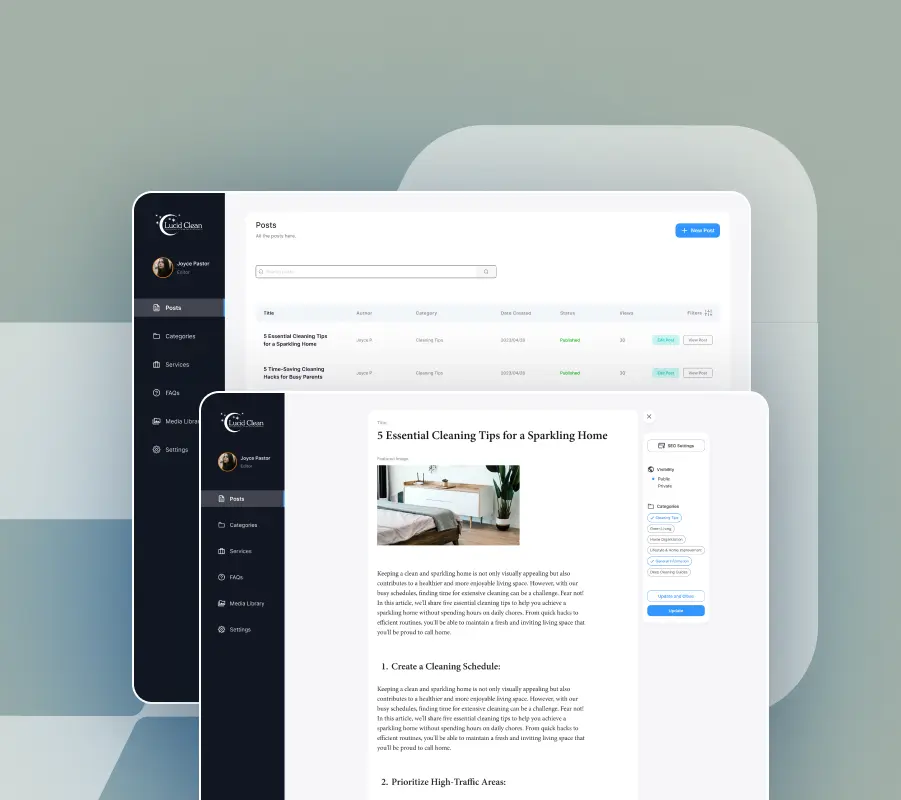
Content Dimension CMS delivers on the promise of modern content management. The dashboard is clean and focused, showing exactly what users need without overwhelming them with options they'll never use.
Page transitions happen instantly through client-side routing. No full-page reloads, no loading spinners. The application feels like native software rather than a web page. This performance isn't achieved through caching tricks; it's baked into the architecture.
The design language is deliberately minimal. Every interface element earns its place. The result is a system that feels premium without trying to impress through visual complexity.
Instant Page Transitions
SvelteKit-powered navigation creates an app-like experience with no perceptible loading between views.
Modern Dashboard
Clean, focused interface that surfaces what matters without WordPress-style option overload.
Simplified Content Editing
WYSIWYG editing that actually works, with clean output and no plugin dependencies.
Built-in Performance
Speed is a feature, not an optimization. The architecture ensures fast experiences without configuration.
The Result
Content Dimension CMS proves that content management doesn't have to be painful. By starting fresh rather than accumulating features, the system achieves something WordPress can't: genuine simplicity without sacrificing capability.
The product serves as both a portfolio piece demonstrating full-stack development skills and a practical tool for managing content without WordPress frustrations. It's used in production, solving real problems for real content creators.
The project demonstrates the value of building solutions to your own problems. The best products come from makers who understand the pain points firsthand.
Reflection
Building a CMS from scratch was ambitious. The scope of a content management system is deceptively large. Authentication, media handling, content modeling, API design. Each feature reveals hidden complexity.
The biggest lesson: constraint is liberating. WordPress tries to be everything for everyone. By deciding what Content Dimension CMS wouldn't do, the product became better at what it would do. Scope discipline is the difference between shipping and stagnating.
SvelteKit proved to be the right choice. The framework's performance characteristics and developer experience made it possible to build something that feels genuinely different from the PHP-era platforms that still dominate the market. The future of content management is JavaScript, not just on the frontend.