

The starting point: invisible on Google.
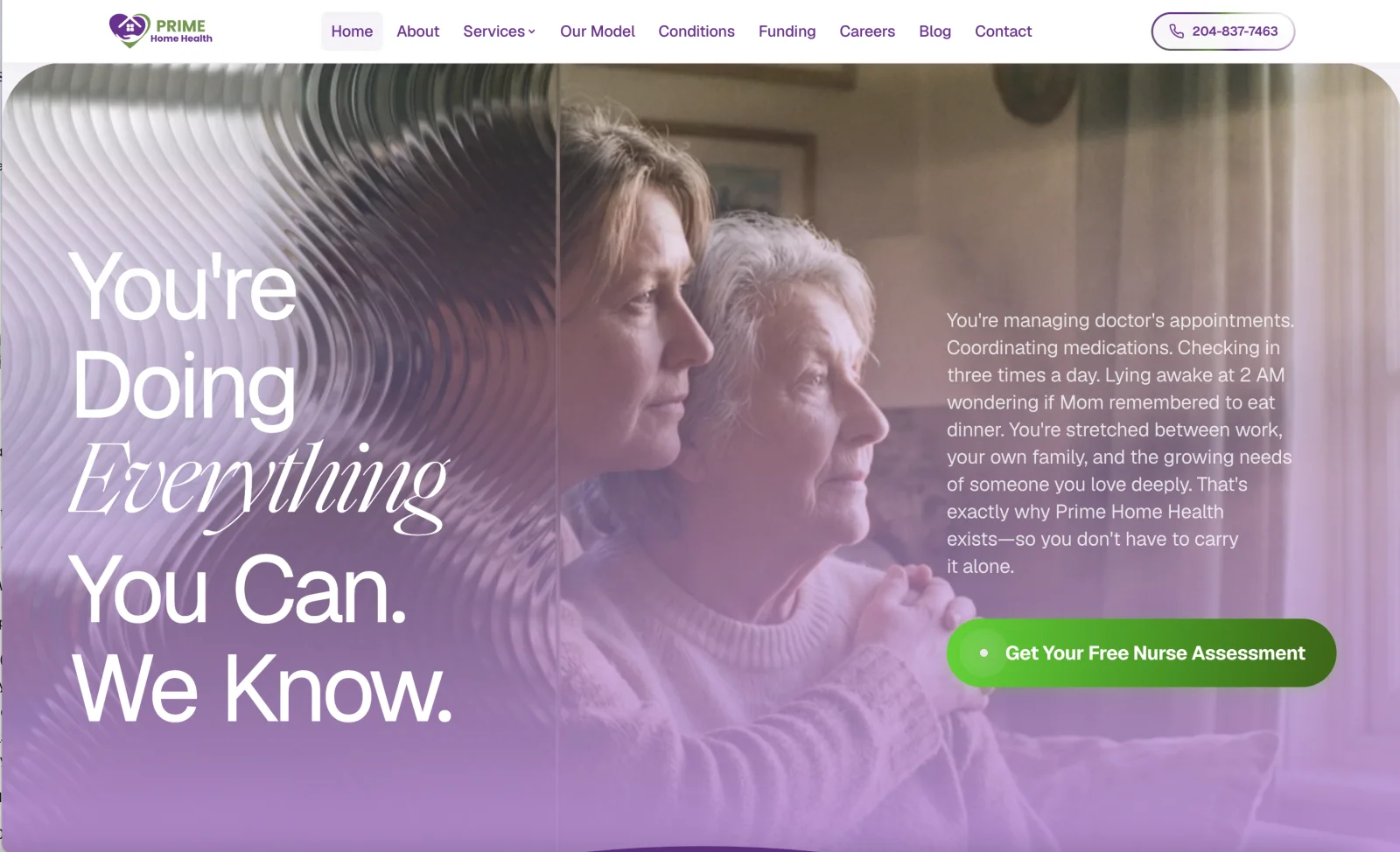
Prime Home Health ran on an old Wix site that nobody could find. This is the story of the rebuild and SEO retainer that fixed it, the kind of custom web design and development work behind every project here. Fewer than 50 pages were indexed. The site pulled roughly 4 clicks a month and showed up in Google about 433 times a month. For a clinic in a city full of families searching for home care, that is almost nothing.
Why it couldn't compete. The problems weren't cosmetic. The site was missing the basics Google needs before it will even consider ranking a page:
Put together, these didn't just lower the rankings. They kept the site out of the race entirely. A page Google can't read, can't present, and finds little substance on doesn't lose. It never gets to compete.
This is how most clients arrive. They start on Wix, WordPress, or a Squarespace template because it's quick and cheap, then a year or two later the same site is quietly bleeding leads because it can't rank. That's the real cost of a cheap DIY build: the monthly fee is small, but the search traffic you never capture is enormous. (I broke this down in detail in custom website vs template, the hidden costs and when each one makes sense.)
And that costs a clinic in a way no dashboard shows. When a family searches "home care services in winnipeg" at 11 PM after a parent comes home from the hospital, they pick from whoever sits on Page 1. Miss that page and you're not in the decision, no matter how good your care is.
Fixing it took two skills that rarely live in one place: a developer who could rebuild the site, and an SEO who could make it rank. Here, that was the same person.
Most SEO people can audit a site but can't rebuild it. Most developers can build a site but don't own the rankings. Hiring a full-stack web developer who does both is what made this possible, so the work started with the foundation.
A full custom rebuild. A ground-up build replaced the Wix site, with clean markup, fast load times, and a structure Google can actually crawl. It runs on Railway behind a Cloudflare proxy, with GitHub CI/CD for safe, repeatable releases. (If you run a clinic, the healthcare website design guide covers the compliance and technical groundwork in depth.)
Indexed pages went from under 50 to 303. This was the biggest unlock. The rebuild grew the indexable surface roughly six times over, and a page Google can't index can't rank for anything. That's the reason impressions multiplied. It's also the part most SEO providers can't deliver, because it means rebuilding the site, not just tuning it.
URLs restructured without losing rank. Every URL was reorganized around clear search intent, with redirect rules mapping each old path to its new home. Zero ranking lost in the move.
With a crawlable foundation in place, an ongoing SEO retainer went after the searches that bring patients. High-intent, local, non-branded terms like "home care winnipeg" and "home care services in winnipeg." Every page was built around what a family is actually trying to find, fast and mobile-first, since responsive design feeds search rankings directly. Progress was tracked against a professional rank tracker, so it was measured, not guessed.
The numbers below come straight from Google Search Console and that third-party rank tracker. Nothing here is an estimate.
Raw clicks aren't the real proof. Impressions and non-branded rankings are. They show Google putting the clinic in front of people searching for care, not just people who already knew the name. Here's what changed, straight from Google Search Console and a professional rank tracker.
Impressions count every time Prime Home Health shows up in Google. They went from 433 to 11,400 a month, and 91% of that is non-branded. That's the honest proof: the rebuild put them in front of strangers actively searching for care, not just people who already knew the name.
Per month · Google Search Console
Before the rebuild, none of these terms ranked. They sat past Page 10 or weren't indexed at all. Now thirteen keywords with 1,000+ monthly searches sit on Page 1. All non-branded, all high-intent, all the exact phrases a family types when they need care today.
| Keyword | Volume | Before | Now |
|---|---|---|---|
| home care winnipeg | 1.3k | 100+ | #5 |
| home health | 1.3k | 100+ | #5 |
| home care services in winnipeg | 1.3k | 100+ | #6 |
| winnipeg home health care | 1.0k | 100+ | #5 |
| home care service winnipeg | 1.0k | 100+ | #7 |
| 24/7 healthcare agency winnipeg Page 1 | n/a | 100+ | #8 |
Position data from a professional rank tracker (independent third-party SERP data).
Organic clicks grew from about 4 a month to 194 a month. Straight talk on that number: roughly three-quarters are branded, meaning people who already knew the clinic and searched the name. So it's real, growing traffic, not 194 strangers. The proof of new reach lives in the impressions and rankings above. The clicks just confirm the traffic is real and climbing.
The signed SEO plan set these milestones for month 6. The clinic hit them in roughly the first 30 days.
Targets from the agreed 6-month SEO proposal (April 2026); actuals as of June 1, 2026.
Twenty hot, urgent inquiries in a month is a pipeline, not a vanity stat. Run the conservative math. Assume only half become clients, so 10. Put that against the home-care industry's average client value:
Illustrative projection using an industry-average client value of $2,070 a month. Actual conversion and retention vary. Home-care clients often stay for many months, so real lifetime value usually runs well past the first year. And since these come from organic rankings, the cost per inquiry keeps falling as the rankings hold.
20 urgent patient inquiries in the first 30 days.
Rankings and impressions are leading indicators. The number that pays the bills is people reaching out. From launch through the end of May, the clinic logged 20 hot, urgent patient inquiries. Families who found them at the exact moment they needed care.
That's already past what the signed 6-month plan projected. And it doesn't reset when a budget pauses, the way ads do. Once the rankings are earned, they keep surfacing the clinic to new families, and the cost per inquiry keeps dropping as those rankings hold.
This is a healthcare site, so it was built privacy-aware from day one. Manitoba clinics are "trustees" under PHIA, the Personal Health Information Act, and the federal PIPEDA covers how a private practice collects personal information through its website. The build reflects that: HTTPS throughout, forms that ask only for what's needed, clear consent language, and no patient information exposed in public.
This shows an awareness of the regulatory landscape. It is not legal advice or a certification of compliance.
Prime Home Health wasn't luck. It's the same local SEO playbook I run on my own site, in one of the most competitive niches there is: web design in the Philippines, against established agencies with bigger teams and budgets.
That's the test that matters. Anyone can rank for easy terms. Ranking at the top for the phrases buyers actually search, in a market full of agencies fighting for them, is the proof the playbook works. Prime Home Health is that same playbook applied to a local healthcare clinic.
Here's how I'd replicate it for you:


Partner with an award-winning web designer and web developer from the Philippines, delivering world-class websites to global brands. 15+ years of experience creating sites that convert visitors into customers.
Local home-care terms like "home care winnipeg," "home care services in winnipeg," and "home care agency winnipeg" come down to three things working together. A fast, crawlable website Google can fully index. Dedicated pages that match each search intent: services, conditions, locations, funding. And a consistent local presence so Google trusts you for the area. For Prime Home Health, the rebuild grew the indexable surface from under 50 pages to 303, and within about a month thirteen terms with 1,000+ monthly searches, including "home care winnipeg," reached Page 1.
For most sites, three to six months before meaningful traffic. Technical and indexation fixes are the exception. They can move within weeks, because the moment Google can crawl and index your pages, you become eligible to rank. Prime Home Health saw most of its movement within roughly 30 days because the old site was badly under-indexed and the rebuild unlocked that surface. That speed is not guaranteed for every site.
Two reasons most local healthcare sites stay invisible. Too few indexed pages, since Google can only rank pages it can crawl and index. And pages that don't clearly match what families search. Before the rebuild, fewer than 50 pages were indexed and the site drew about four clicks a month. After the rebuild and an SEO retainer, impressions grew from 433 to 11,400 a month, and 91% of them were non-branded searches from people who had never heard of the clinic.
Branded searches use the business name, like "prime home health winnipeg." Non-branded searches describe the need, like "home care near me," "healthcare agencies in winnipeg," or "long term care winnipeg." Non-branded terms are where new patients discover you, so they are the real measure of growth. For this clinic, 91% of impressions are non-branded. That is proof the site now reaches families actively searching for care, not just people who already knew the name.
Ideally both, and that's the gap most providers hit. An SEO can optimize an existing site, but if the site can't be properly crawled, indexed, or restructured, the ceiling is low. A developer can build a fast, clean site but may not own the rankings. This project did both: a full custom rebuild on modern infrastructure, plus an ongoing healthcare SEO retainer targeting the local terms patients actually search.
Start with a free strategy call. The Prime Home Health result came from a repeatable local SEO playbook: rebuild the technical foundation so Google can index the site, map the high-intent keywords your customers actually search, build pages that match that intent, then track and compound the rankings. It's the same approach that ranks my own site Top 1 to 3 for 50+ competitive web design keywords in the Philippines, against established agencies. On the call we'll look at your market, your competitors, and the terms worth winning, then map out what it would take to get you there.