
Mental Health & Psychology Practice Website Design: Calm Enough to Earn the First Call






A worried parent at 11pm. A spouse who finally agreed to get help and might change their mind by morning. Someone three days into a panic spiral, scrolling on their phone. These are the people landing on a behavioral health site, and they decide in seconds whether you feel safe enough to call. Stock photos, clinical jargon, a contact form that asks for everything and routes nowhere, and they're gone, back to the group down the road with a clearer "request an appointment" path.
A psychology practice site carries a heavier load than most: calm an anxious visitor, reassure a skeptical one, present a dozen clinicians without becoming a directory, route admissions to the right intake coordinator, and handle protected health information honestly. HIPAA is a US law about how that information is treated, not a badge you buy, so PHI gets handled through safe forms, scheduling, and analytics rather than overlays and compliance theater. That takes a custom build, and 15 years of it is what I bring as the web designer and developer you'd work with directly. This page is for group practices and treatment centers; solo private-pay therapists should see my therapist website design page.Key Takeaways:
- Behavioral health buyers often arrive overwhelmed or in crisis - calming, trust-building design has to convert without adding friction.
- Per-provider profiles let multi-clinician practices present a full roster without devolving into a hard-to-navigate directory.
- Admissions-focused conversion paths route intake inquiries to the right coordinator instead of dead-ending at a generic contact form.
- HIPAA is US law and no website is "HIPAA-certified" - PHI is protected through secure forms, scheduling, and analytics, not a compliance badge.
- Confidentiality-safe testimonials build trust without exposing client identities or violating privacy expectations.
- Scheduling, intake, and EHR integration connect the site to the tools your practice already runs on.
- Accessibility for mental health users and behavioral-health SEO widen reach to the people actively searching for care.
The Behavioral Health Buyer Is Already Overwhelmed
Someone searching for a psychologist, an intensive outpatient program, or a treatment center is rarely calm. They're anxious, grieving, exhausted, or making the call on behalf of a family member who won't. Your website is the first nervous system they touch.
That changes the design brief. Cluttered layouts, autoplay video, aggressive popups, and dense walls of text all raise the visitor's stress and push them to close the tab. Calm is not a mood board choice here - it's a conversion lever.
The goal of every page is to lower friction and answer the quiet questions running in the background. Will I be judged? Is this covered by insurance? How fast can I get in? Who will I actually be talking to? When the site answers those before they're asked, the inquiry follows.
Calming, Trust-Building Design That Still Converts
Trust in behavioral health is earned through restraint. Generous white space, soft but accessible color contrast, real photography of your space and team where consent allows, and typography that's easy on tired eyes do more for conversion than any flashy effect.
I design quiet interfaces with purposeful motion - subtle transitions that guide attention, never gimmicks that demand it. The aesthetic signals competence and safety, which is exactly what an admissions-intent visitor is scanning for. This restraint-first approach is the same one that earned CSS Design Awards recognition for UX, UI, and Innovation.Trust also comes from specificity. Naming your modalities (CBT, DBT, EMDR, ACT), your levels of care, your insurance relationships, and your real team builds far more credibility than a page of reassuring adjectives. Vague sites read as either inexperienced or evasive - neither helps a worried visitor decide.
Per-Provider Profiles for Multi-Clinician Practices
A group practice lives and dies by its provider profiles. Visitors don't choose a clinic in the abstract - they choose a person they think can help them. Thin, identical bio cards waste your most persuasive asset.
I build provider profiles as proper structured content, not a static page someone has to redesign every time you hire. Each clinician gets a profile with their photo, credentials, specialties, modalities, accepted insurance, languages, telehealth availability, and a warm, human bio. New hire? Add a record. Someone leaves? Archive it. No developer required.
Filtering and Matching
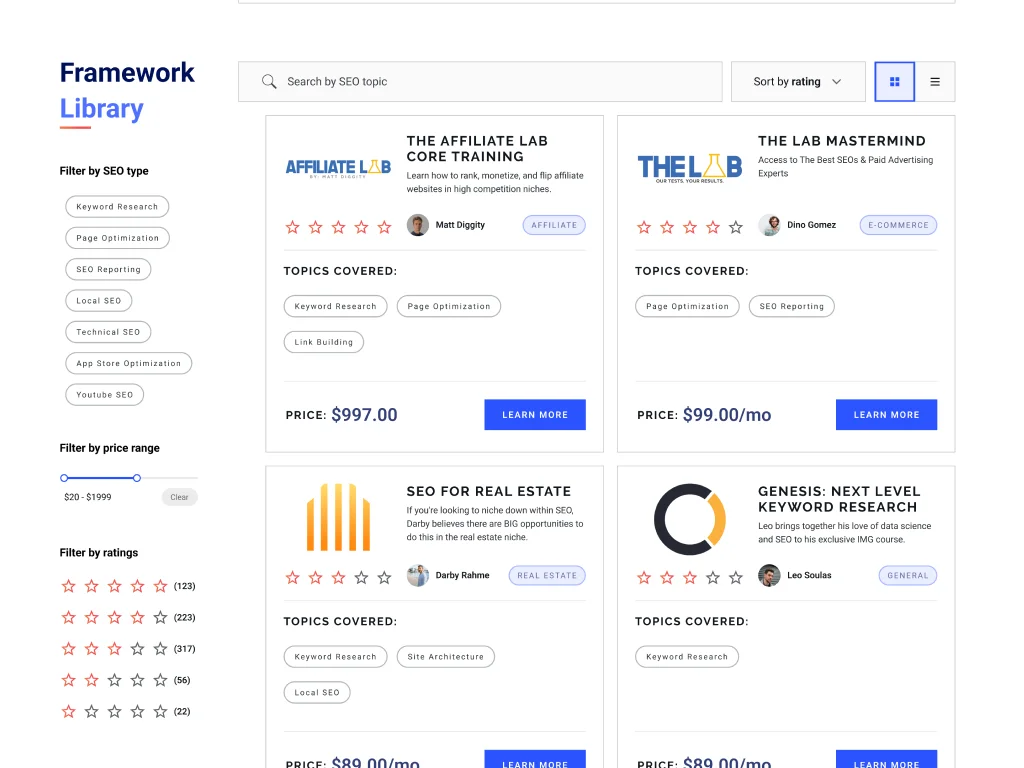
When you have ten or thirty clinicians, the visitor needs help narrowing down. I build filtered directories - by specialty, insurance, location, language, telehealth, accepting-new-clients status - so a visitor can self-match in seconds instead of scrolling a wall of faces.
That matching is also an intake accelerator. A visitor who finds "a Tagalog-speaking trauma therapist who takes my insurance and has openings" is far closer to booking than one staring at an undifferentiated list. The custom CMS behind this is part of the healthcare website design work I do across practice types.Admissions-Focused Conversion Paths and Intake Routing
Treatment centers and group practices don't need "more traffic" as much as they need the right inquiry reaching the right person fast. The site's job is to qualify gently and route precisely.
I map distinct conversion paths for distinct intents. A self-pay individual, a family member researching for a loved one, a referring physician, and an insurance-verification request are four different journeys - each gets its own clear call to action and its own destination, not one generic "Contact Us" form.
Routing the Inquiry
Behind the forms, I build conditional intake routing. Based on what the visitor selects - level of care, location, insurance, urgency - the submission lands with the correct intake coordinator or admissions team, with the context they need to respond well. Less triage by hand, faster response, fewer leads going cold.
Speed matters more in behavioral health than almost anywhere. The practice that responds first usually wins the client. A well-built intake flow plus instant routing is the difference between a booked assessment and a voicemail nobody returns. If you want this kind of path mapped for your practice, book a discovery call and we'll diagram it together.HIPAA, Done Honestly
Let's be direct, because the marketing around this is full of nonsense. There is no such thing as a "HIPAA-certified website" or a builder that's "HIPAA-compliant out of the box." HIPAA is a US federal law, and compliance is a system - administrative, physical, and technical safeguards, plus signed Business Associate Agreements with every vendor that touches protected health information.
For a behavioral health practice, where the diagnosis itself is sensitive PHI, the technical baseline is non-negotiable. Intake forms must submit to encrypted, access-controlled storage - never to plain email. Your analytics and ad pixels must not capture PHI or be allowed to phone it home to a third party without a BAA. Standard Google Analytics and the Meta Pixel are common liabilities here.
I build the technical layer correctly: secure intake submission, no PHI in email or analytics, privacy-first analytics that don't require a consent banner, and BAAs with any data tool in the stack. The rest of compliance - your policies, training, and risk analysis - lives with you and your compliance counsel.
For the deeper technical picture, see my pages on HIPAA-compliant website design and the specific HIPAA website requirements that apply to forms, hosting, and tracking.Canadian Practices: PIPEDA and Provincial Health Law
Canada has no HIPAA. Private-sector data is governed federally by PIPEDA, layered with a provincial health information act - PHIPA in Ontario, PHIA in Manitoba, Nova Scotia, and Newfoundland & Labrador, PHIPAA in New Brunswick, and HIA in Alberta. The principles rhyme with HIPAA, but the rules and the language are different, and conflating them is a red flag in any vendor.
I've built and maintain a compliant site under Manitoba's PHIA, so this isn't theoretical. If you're Canadian, my PHIA and PIPEDA compliant healthcare website page covers it in depth.Prime Home Health: Enquiries After the Rebuild, Search Growth Through SEO
Prime Home Health is a Winnipeg home-care provider. Its old Wix website already had branded search traffic, but its rushed template presentation did not convey the trust families needed to enquire.
The custom rebuild brought 30+ enquiries in the first 30 days: 20 form enquiries, plus an estimated 10–20 phone enquiries according to the client. I attribute the early surge primarily to the rebuild making better use of existing interest. Ongoing SEO subsequently brought more search traffic.
The August SEO report compares July 15–August 11, 2026 with June 17–July 14, 2026, two equal 28-day periods:| Metric | August report result |
|---|---|
| Organic clicks | 502, up 28% |
| Search impressions | 26,100, up 29% |
| Tracked keywords in the top 10 | 66 |
Read the [Prime Home Health case study](/case-studies/prime-home-health) for the report images, enquiry breakdown and project timeline.
The Korawells wellness clinic is close in spirit to behavioral health: a sensitive, wellness-focused practice where the design had to feel warm and safe without losing credibility. We built it privacy-first and accessible, and it earned international design awards for UI, UX, and innovation. Calm, trust-building design and strong conversion are not at odds.Scheduling, Intake, and EHR Integration
Most behavioral health practices already run on a clinical platform - SimplePractice, Jane App, TherapyNotes, or similar - and the website needs to hand off to it cleanly. The wrong integration either breaks the calm experience or quietly creates a compliance gap.
I integrate scheduling and intake the right way for your stack. That means embedded or linked booking that respects PHI boundaries, client-portal handoffs that don't leak data, and confirming a BAA is in place before any tool touches patient information. SimplePractice and Jane App both support healthcare-grade handling - the implementation just has to be done deliberately.
For practices that want to go further - online appointment requests, insurance verification intake, telehealth entry points - I build those flows custom. See patient booking and scheduling integration and, for virtual care, telehealth website design.Accessibility for Mental Health Users
Accessibility is both a legal expectation and a clinical courtesy. In Ontario, AODA requires WCAG 2.0 AA. Across the US and Canada, ADA and human-rights expectations push the same direction. For behavioral health specifically, the users you're serving may be navigating anxiety, depression, ADHD, cognitive load from medication, or a crisis state.
That raises the bar. Clear focus states, generous tap targets, readable contrast, predictable navigation, no flashing motion, plain-language copy, and full keyboard and screen-reader support aren't extras - they're what makes the site usable for someone who's struggling.
One firm warning: accessibility overlay widgets like accessiBe, AudioEye, and UserWay are not compliance. They've been named in lawsuits and frequently make things worse for real assistive-technology users. I fix accessibility at the code level, where it actually holds up. More on the approach at healthcare website accessibility. _This is guidance, not legal advice._SEO for Behavioral Health Practices
Search is how most admissions journeys begin. Someone types "DBT program near me," "psychologist that takes [insurance]," or "intensive outpatient for teens," and whoever ranks and loads fast gets the call. Custom code wins here because Google rewards speed, clean structure, and crawlable content - exactly what a template-heavy builder struggles to deliver.
I structure the site around real search demand: dedicated pages per service line and level of care, per-provider pages that rank for specialty-plus-location queries, and genuinely helpful content that answers the questions worried visitors actually type. The Prime Home Health result above is what that approach produces when it's executed properly.
Behavioral health SEO also rewards trust signals that Google reads as expertise and authority - clear clinician credentials, accreditations, structured data, and accurate, current information. I build all of that in, including Service and FAQ schema so your pages are eligible for rich results.
Custom Build vs. Template: Why It Matters Here
You can stand up a behavioral health site on Squarespace, Wix, or a WordPress theme. The problem is everything that makes a behavioral health site actually work fights against those tools: real intake routing, a filterable provider directory, PHI-safe forms, privacy-first analytics, accessibility that survives an audit, and the page speed that drives ranking and calm.
| Template builder | Custom SvelteKit build | |
|---|---|---|
| PHI-safe intake forms | Risky / plugin-dependent | Built correctly from the start |
| Provider directory + filtering | Manual, fragile | Structured CMS, self-serve |
| Intake routing logic | Limited | Fully custom |
| Page speed | Theme-bloated | 95–100 Lighthouse |
| Accessibility | Overlay band-aids | Code-level, audit-ready |
| Analytics privacy | Pixel liabilities | Privacy-first, no consent banner |
Process, Pricing, and Timeline
I work solo, which means you talk to the person actually designing and building your site - no account managers, no junior handoffs. The project runs through seven stages you can track in your client portal: onboarding, brand identity and strategy, UX (SEO, information architecture, copy), Figma design with a component system and motion direction, the custom SvelteKit build with your CMS and integrations on staging, testing (every device, Lighthouse 95-100, accessibility), and offboarding with production deploy, Search Console setup, CMS training, and 30 days of post-launch support. I design in Figma and translate it to pixel-perfect code with an AI-assisted Figma workflow, so what you approve is what ships.
Most multi-provider behavioral health practices fit Bespoke Pro at $5,000 (roughly 4 to 6 weeks), which covers content editing, privacy-first analytics, advanced page transitions, and a light custom CRM for non-sensitive business enquiries and follow-ups. Treatment centers needing full-site content editing, reusable page layouts, and lead reporting can choose Bespoke Max at $8,000. Sensitive patient intake stays in an approved healthcare system, with specialized integrations scoped separately. Smaller group practices can start with Express at $3,000.
For a full breakdown of what drives cost, see healthcare website design cost. When you're ready, let's talk about your practice and scope it properly.


Transform your website into a revenue-generating asset
Partner with an award-winning web designer and web developer from the Philippines, delivering world-class websites to global brands. 15+ years of experience creating sites that convert visitors into customers.
Frequently Asked Questions
-
Yes. This page is for group practices, multi-clinician clinics, and treatment centers with admissions and intake needs - filterable provider directories, conditional routing, multiple service lines. The therapist website design page is built for solo private-pay clinicians with a simpler, more personal scope.
-
I build the technical layer that compliance depends on - secure intake storage, no PHI in email or analytics, privacy-first tracking, and BAAs with any vendor touching PHI. But no website is "HIPAA-certified," and compliance is a whole system including your policies, training, and risk analysis. I handle the build correctly and work alongside your compliance counsel.
-
Yes. Canada has no HIPAA - you're governed by federal PIPEDA plus your provincial health act, such as PHIPA in Ontario or PHIA in Manitoba. I currently maintain a compliant site under Manitoba's PHIA, so I build to the correct framework rather than assuming US rules apply.
-
Carefully and ethically. Instead of named client stories, I use anonymized or composite statements with disclaimers, accreditations, professional memberships, aggregate data, and voluntarily-left reviews. The goal is real credibility without exposing any client's identity or running into your licensing board's rules.
-
Yes. Both are common in behavioral health and both support healthcare-grade handling. I integrate scheduling and intake so the handoff respects PHI boundaries and a BAA is in place before any tool touches patient data. I can also build custom appointment-request and insurance-verification flows on top.
-
Most multi-provider practices land in the 4 to 6 week range for a Bespoke Pro build. Treatment centers with full intake applications and integrations run longer, around 8 to 10 weeks. Timelines depend on how many providers, service lines, and custom flows are involved, plus content readiness.
-
Smaller group-practice websites typically start with Express at $3,000, most multi-clinician practices fit Bespoke Pro at $5,000 with a light custom CRM for non-sensitive business enquiries, and treatment centers needing full-site editing and lead reporting fit Bespoke Max at $8,000. Sensitive patient intake and specialized integrations are separately scoped.
-
No. Tools like accessiBe, AudioEye, and UserWay are not compliance and have been named in lawsuits - they often make things worse for real assistive-technology users. Genuine accessibility is fixed at the code level, which is how I build it. This is informational, not legal advice.
-
Behavioral health sites need PHI-safe forms, intake routing, filterable provider directories, code-level accessibility, and the page speed that drives both ranking and a calm experience. Template builders fight all of that. A custom SvelteKit build delivers them cleanly and scores 95 to 100 on Lighthouse.
-
That's the whole point. Prime Home Health already had branded traffic, but its old website generated no enquiries. The custom rebuild brought 30+ enquiries in the first 30 days: 20 form enquiries, plus an estimated 10–20 phone enquiries according to the client. Ongoing SEO then expanded search traffic: the August 2026 report records 502 clicks (+28% over the prior 28 days) and 66 tracked keywords in the top 10. The same approach - dedicated service pages, per-provider pages, helpful content, and clean technical SEO - is what I build for behavioral health practices.